
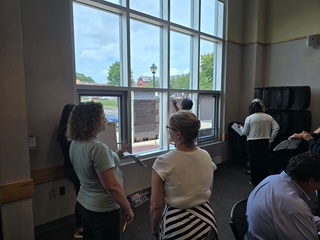
Yesterday, I had the opportunity to participate for the first time in the annual strategic planning meeting of the Calvert County Early Childhood Advisory Council. As someone relatively new to Calvert County—but certainly not new to early childhood systems—I arrived eager to listen, learn, meet people, and better understand the programs serving young children and families in my new community.
I left feeling welcomed, energized, and encouraged.
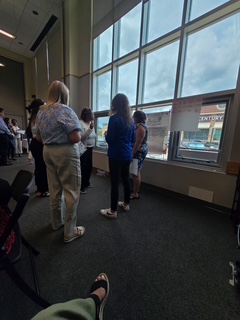
Head Start Calvert County took the lead in planning, organizing, facilitating and supporting the resources for the meeting which brought together professionals representing a range of early childhood, education, family-support, and community resources. Those present included representatives from Calvert County Public Schools Head Start, the Judy Centers, HIPPY, Calvert Library, early childhood education, intervention and special education services, and other community partners. I hope to add a more complete list when it becomes available.
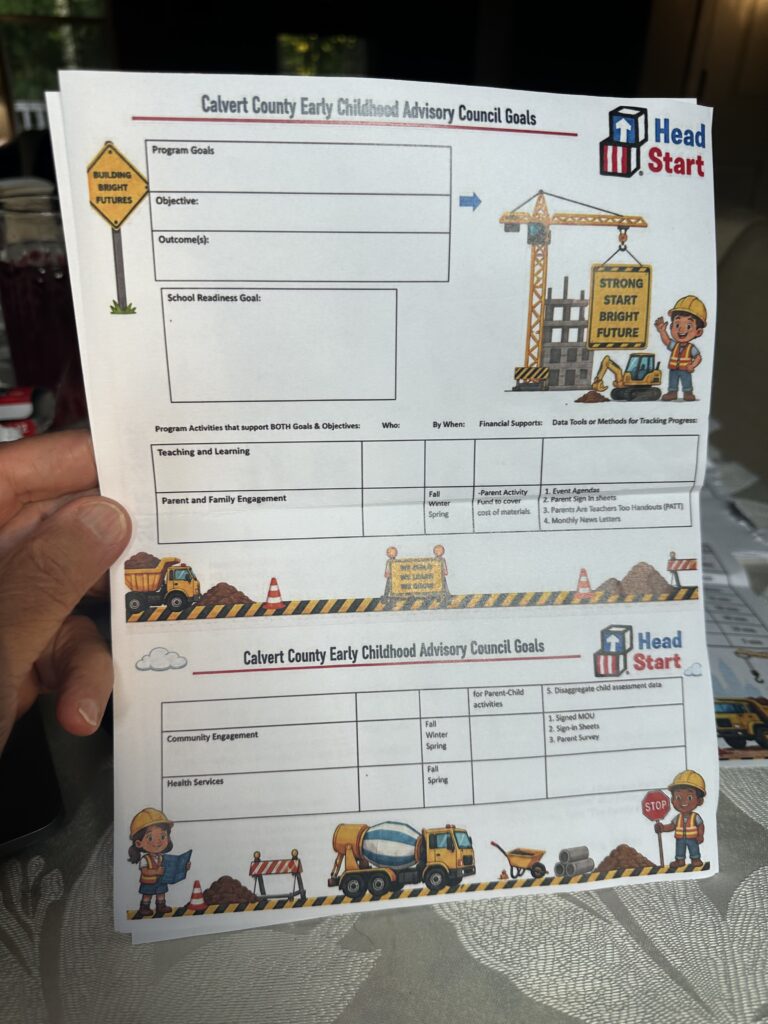
The purpose of the meeting was practical and important: to conduct the Council’s annual strategic planning for the 2026–2027 year. Participants worked in groups to develop a shared community events calendar and to begin establishing the Council’s annual goals, objectives, activities, responsibilities, timelines, financial supports, and methods for measuring progress.
The planning template reflected the breadth of the work. It asked participants to consider teaching and learning, parent and family engagement, community engagement, health services, school readiness, financial resources, and the data needed to determine whether the Council’s efforts are making a difference.
Those categories matter. But what stayed with me most was not simply the planning work itself, but the spirit in which it was carried out.
From my place as a first-time participant, I was struck by the sense of shared purpose in the room. People spoke with knowledge of their own programs, but also with genuine familiarity and respect for the work of their community partners. The relationships felt established and authentic—not merely the result of organizations appearing together on a partnership list.
Just as noticeable was the ease with which people worked across programs and roles. Ideas seemed to be valued according to their usefulness to the task rather than the title of the person offering them. The conversation did not feel constrained by organizational boundaries or hierarchy. Instead, it felt like a group of people who knew one another, trusted one another, and were accustomed to working toward something larger than any single program.
That experience reinforced something I have come to believe over many years in early childhood work: collaboration is most powerful when people are able to lead from their knowledge, experience, relationships, and commitment—not only from their position on an organizational chart.
Early childhood systems require this kind of flexibility. Supporting children and families involves people working across programs, professions, funding streams, eligibility requirements, and institutional boundaries. No single agency can meet every need, and no organizational chart can anticipate every moment when someone’s particular expertise will be needed.
Organizations and partnerships become stronger when they can recognize leadership wherever it emerges and create space for people to become champions of the work at hand. That kind of culture tends to produce not only happier workplaces, but more responsive and effective services for children and families.
The plans developed during the meeting will eventually take shape as goals, activities, timelines, community events, and measures of progress. Those products matter. What gave me confidence, however, was the evident commitment of the people who will carry them forward.
One theme surfaced repeatedly during the planning conversations: the challenge is not always a shortage of ideas or possible resources. Often, the limiting factor is the time required to identify opportunities, investigate them, build the necessary connections, and move them toward action. That is an area in which I may be able to help. I bring many years of early childhood systems, Head Start, planning, research, and organizational experience—and, as a new Calvert County neighbor, I currently have both the interest and the capacity to contribute where an extra set of experienced hands might help good ideas move forward.
I am grateful for the welcome I received and for the opportunity to begin learning from this group. I left with new connections, several ideas I hope to explore through future conversations, and a genuine sense of excitement about becoming part of Calvert County’s early childhood community. I hope to be not only an admirer of the work already underway, but also a useful neighbor and champion for the people doing it.
Points to Ponder
How can the Council make the full range of local early childhood and family resources easier for families—and professionals—to understand and access?
Where are families most likely to encounter gaps between programs, eligibility systems, age groups, or service providers?
How can parent and family voices become part of planning, implementation, and evaluation rather than a separate engagement activity?
What information will help the Council distinguish between activities completed and measurable improvements experienced by children and families?
What potentially valuable opportunities are local programs unable to pursue simply because no one currently has the time to research, coordinate, or champion them?
Continuing the Conversation
I welcome conversations with Calvert County early childhood programs and community partners about promising ideas, overlooked opportunities, resource development, planning needs, or projects that have been difficult to pursue because staff time is limited.